News
Power Space tailor-made dust removal plan for you
How Electrostatic Oil Mist Collectors Work
What is the working principle of an electrostatic oil mist collector?
An electrostatic oil mist collector purifies dirty factory air through a sequential 4-stage thermodynamic and electrical process. As oil smoke enters the CNC oil mist purifier, it first passes through a mechanical Pre-filter to catch coarse dust and droplets. The air stream then moves into a high-voltage ionization zone, where the passing oil mist particles are charging positively or negatively. Next, these charged particles enter the collection area (oil mist collection area), where alternating positive electrodes and negative electrodes generate a strong static field that traps the aerosols on the collection plates. Finally, the air passes through a Rear filter, discharging 100% clean air back into the workshop.
1. Step-by-Step Technical Breakdown: The Pre-filter to Rear Filter Flow
According to the engineering diagram, the internal mechanical-to-electrical pipeline inside the industrial oil mist extraction system follows a strict linear sequence to ensure high collection efficiency:
Step 1: The Outer Front Wave Net (Pre-filter)
The process begins at the oil smoke area, where high-velocity Dirty Air carrying mixed oil mist particles is drawn into the system. It immediately encounters the Pre-filter (outer front wave net), which absorbs large gas dust, heavy fluid droplets, and flying metallic chips. This stage protects the delicate electrical grids downstream from grounding out or short-circuiting.
Step 2: The Ionization Zone (Particle Charging)
After passing the pre-filter, the remaining fine aerosols enter the ionization zone. Backed by a high-voltage electrostatic generator, this zone applies heavy static electricity to the ionizer needles. As the fine micro-particles flow through the ionizer gaps, they become heavily Charged oil mist particles (polarized with explicit positive or negative charges).
Step 3: The Oil Mist Collection Area (Static Precipitation)
The newly charged oil mist then travels into the collection area. This module is engineered with parallel, alternating metal sheets:
Positive Electrodes (+)
Negative Electrodes (-)
The electrostatic forces of repulsion and attraction drive the charged particles out of the moving airstream. Positively charged particles are pulled rapidly toward the negative plates, while negatively charged elements adhere to the positive plates. This creates a highly concentrated collection box where oil layers merge, liquefy, and continuously drain.
Step 4: The Rear Filter (Final Safeguard)
Before returning to the facility environment, the ionized, filtered air is pushed through a dedicated Rear filter. This final matrix traps any remaining traces, ensuring that the processed air fully complies with indoor emission standards, releasing only pristine Clean air back into the shop floor.
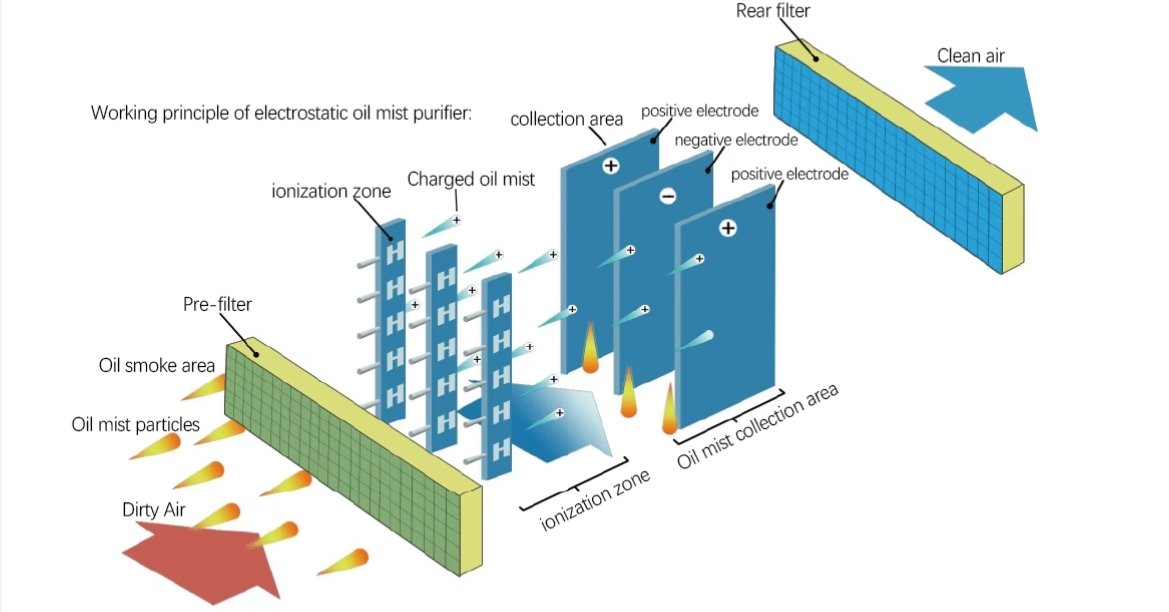
2. Engineering Comparison Matrix: Diagram-Driven Analysis
| Component Stage | Core Technical Function |
| Pre-filter Layer | Filters coarse dust & large gas droplets. |
| Ionization Zone | Polarizes sub-micron particles with electrostatic charges. |
| Collection Area | Alternates positive/negative electrodes to trap charged oil. |
| Rear Filter Layer | Conducts a secondary clean-side polishing cycle. |
3. FAQ
Q: Why does the electrostatic oil mist purifier require both an ionization zone and a collection area?
A: Sub-micron oil smoke particles carry no natural charge and pass straight through wide metal plates. The ionization zone acts as a charging station that forces particles to hold an electrical charge. Once charged, the alternating positive and negative electrodes in the collection area can easily attract and trap them via static force.
Q: What is the purpose of the Rear filter shown in the engineering schematic?
A: The Rear filter acts as a final fail-safe. If massive waves of smoke momentarily overload the collection plates, or if minor pressure fluctuations occur within the system, the rear filter catches the bypass. This layer guarantees that the air escaping into the factory floor is strictly clean, purified air.
Q: Can this system be used as a standard accessory for all CNC machine tools?
A: Yes. Modern manufacturing regulations require a safe working environment. Integrating a compact industrial oil mist extraction system directly onto a CNC machine center creates a self-contained vacuum environment, protecting the operator from inhaling toxic metal-working fluid mist.