News
Power Space tailor-made dust removal plan for you
Case Study: Implementing Downdraft Grinding Tables in Metal Fab
How can an industrial facility optimize air quality when handling heavy metal grinding and welding?
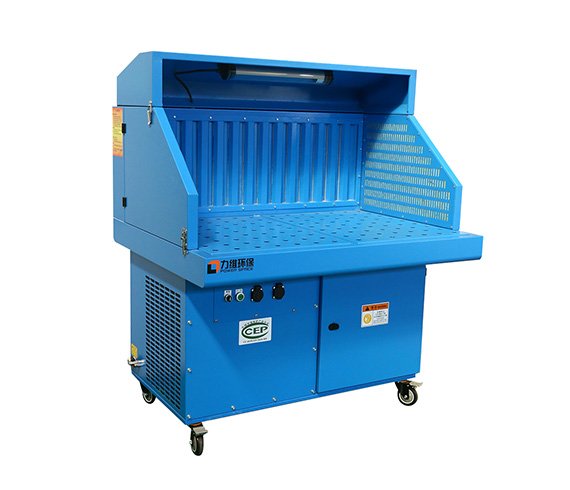
In high-intensity metal finishing shops, traditional overhead hoods often pull hazardous contaminants upward through the worker's breathing zone before exhausting them. In our latest project, a heavy equipment fabricator resolved this issue by replacing their general ventilation setup with the Power Space Downdraft Grinding Table. By pulling heavy dust, hazardous metal oxides, and high-velocity sparks downward right at the source, these self-contained workstations achieved a 99.9% sub-micron purification rate. Featuring integrated mechanical spark baffles and automatic pulse-jet filter cleaning, the upgrade eliminated workshop cross-drafts, ensured compliance, and significantly lowered HVAC energy costs through clean indoor air recirculation.
1. Case Study: Overcoming the Challenges of High-Volume Metal Finishing
The Client Profile & Facility Setup
Our client operates a large-scale steel structural component fabrication plant with multiple manual grinding, deburring, and touch-up welding stations running across consecutive daily shifts.
The Core Obstacles:
The Breathing Zone Hazard: The facility previously used hanging snorkel arms and general extraction hoods. Because grinding dust has significant kinetic energy, particles frequently bounced past the hoods, forcing operators to inhale fine metallic dust and abrasive grit.
Severe Spark and Fire Risks: Heavy carbon steel grinding creates a high volume of incandescent sparks. The facility struggled with localized filter scorching and small ductwork fires in their older ventilation configurations due to a lack of proper inline cooling barriers.
High Operational Energy Waste: Their older centralized dust collectors vented massive amounts of indoor air to the outside, causing their building's HVAC systems to work overtime to maintain comfortable indoor temperatures during seasonal extremes.
To resolve these interconnected bottlenecks, they needed a self-contained, structural workstation that combined heavy material support with bottom-draw filtration—the welding downdraft table.
2. The Engineered Solution: Point-to-Point Downdraft Extraction
Power Space replaced the compromised overhead snorkel lines with a dedicated row of heavy-duty downdraft grinding tables, establishing a localized source-capture grid.
[Grinding/Welding Fumes] ➔ [Perforated Surface Negative Pressure Grid] ➔ [Gravity Slag Drop Trap] ➔ [Labyrinth Spark Arrestor Baffles] ➔ [PTFE Membrane Cartridges] ➔ [Clean Recirculated Exhaust]
Key Implementation Details:
Dual-Zone Capture Velocity: The tables were engineered to pull air both through the bottom perforated work surface and a specialized backdraft panel. This dual-zone approach ensures that even smoke rising from taller components is caught instantly.
Integrated Spark Separation Labyrinth: Placed directly beneath the work grid, an initial gravity settling chamber drops heavy metal slag out of the airflow path. The lighter sparks then strike a heavy mechanical steel baffle that safely cools them down long before they reach the filter chamber.
Premium PTFE Surface Filtration: To handle fine iron oxides and grinding dust, the units were fitted with imported PTFE membrane cartridges. This non-stick coating forces dust to collect strictly on the outermost layer of the pleats rather than embedding deeply into the media.
3. Project Performance & Quantifiable ROI
Following a 90-day post-installation evaluation, the factory floor recorded highly positive shifts across all targeted air quality and operational parameters:
| Performance Metric | Before Power Space Implementation | After Power Space Installation |
| Operator Breathing Zone PM2.5 | Frequently exceeded safe OSHA limits | Reduced by over 95% into optimal safety zones |
| Filtration Efficiency Rate | $80\% - 85\%$ (Visible smoke escape) | $\ge 99.9\%$ down to $0.3\text{ }\mu\text{m}$ particulate sizes |
| System Fire/Scorching Incidents | Multiple filter burn scares annually | Zero incidents due to multi-stage spark traps |
| Ductwork Footprint | Obstructed overhead crane pathways | Zero ductwork footprint, standalone plug-and-play |
| HVAC Energy Conservation | Continuous high building exhaust loss | Significant savings via indoor air recirculation |
4. FAQ Module: Application & Sizing Insights
Q: Can these tables handle heavy workpieces without bending or warping over time?
A: Yes. Power Space industrial downdraft grinding tables are constructed with a reinforced structural steel framework. The standard work surface is engineered to support heavy industrial castings and large metal fabrications up to several hundred kilograms without compromising structure or negative pressure distribution.
Q: How does the client handle filter maintenance during continuous production shifts?
A: The workstations are equipped with an intelligent automatic pulse-jet cleaning program. It monitors static pressure and delivers targeted bursts of compressed air down through the inner core of the PTFE filters. This sheds the dust cake directly into the lower collection drawer without forcing operators to stop their work.
Q: Is it safe to perform manual welding on a downdraft table originally optimized for grinding?
A: Absolutely. A premium welding downdraft table serves a dual purpose. The surface is built to withstand high welding heat and can be fitted with ground clamps. However, operators must empty the lower dust drawers regularly when switching between different metals (like aluminum and steel) to prevent hazardous particulate mixing.