News
Power Space tailor-made dust removal plan for you
How to Solve Fume Extraction in Robotic Welding Cells
Automated MIG/MAG robotic welding cells generate ultra-fine metallic fumes (0.1-1μm, rich in Fe2O3 and MnO), high thermal buoyancy, and red-hot spatter. Poor extraction design either fails occupational health limits or disrupts the active Ar/CO2 gas shield, causing weld porosity.
This guide matches your core product line to proven engineering architectures for robotic cells, featuring dedicated welding booth containment.
1. Core Extraction Architecture & Product Matching
| Robotic Cell Type | Primary Challenge | Recommended Architecture | Matching Product Line |
| Precision Automotive / Multi-axis Thin Plate | Tight space, repetitive high-speed path, zero weld shielding turbulence | On-Torch High-Vacuum (12-22 kPa) | Portable On-gun High Vacuum Fume Extractor |
| Heavy Machinery / Large Fixture / Positioner | High thermal plume, heavy smoke volume, fixed part geometry | Overhead Hood + Cartridge Filtration (2-3.5kPa}) | Cartridge Dust Collector + Overhead Hood |
| Multi-Robot Cell / Safety Enclosure / High Compliance | Arc flash containment, localized cross-draft control, complete volume capture | Modular/Custom Welding Booth + High-Volume Filtration | Cartridge Dust Collector (Configured with Welding Booth / Sidewall/Downward Draft) |
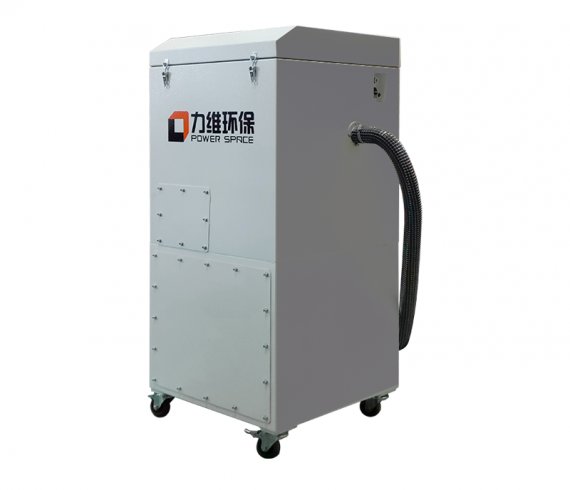
| Flexible / Open-layout / Multi-model Cell | Changing fixture layout, spot maintenance, secondary manual-assist | Movable Flexible Capture | Mobile Welding Fume Extractor |
2. Product-to-Solution Implementation
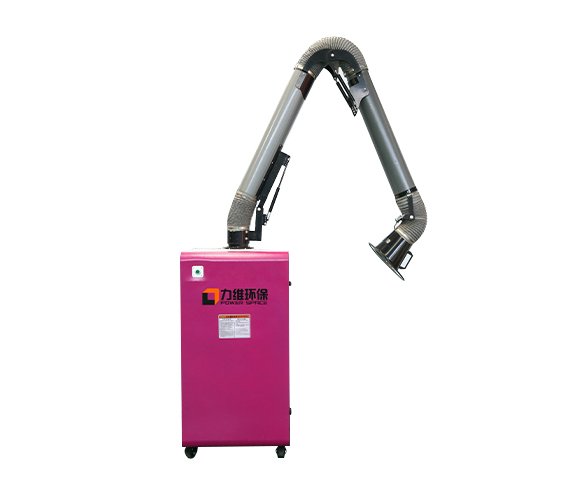
A. Source-Level Precision: Portable On-Gun High Vacuum Fume Extractor
Best for: Robot torches with integrated extraction nozzles.
Working Principle: High negative pressure (15-20 kPa) strips smoke right at the arc pool before thermal buoyancy disperses it.
Key Specs:
Air volume: 90-150m³/h per torch.
Filtration: PTFE-coated cartridge (>99.9% efficiency for sub-micron particles) + integrated spark trap.
Engineering Tip: Manage dresspack (robot dresspack hose weight load ≤ 3-5kg) to prevent joint torsion fatigue.

(On-gun fume extractor with robot arm)
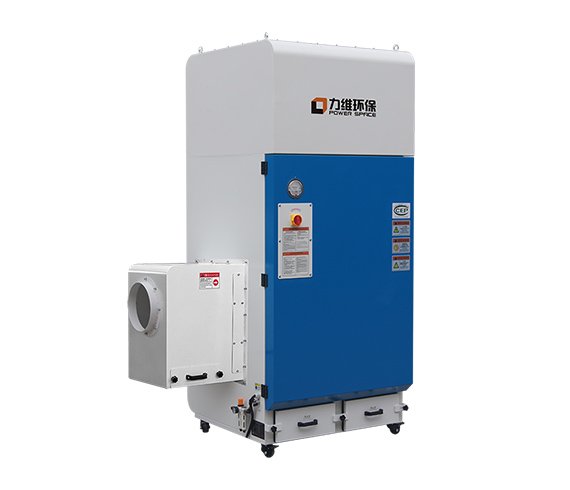
B. Volume & Thermal Plume Control: Cartridge Dust Collector + Overhead Hood
Best for: Open or semi-enclosed large robotic fixture cells requiring canopy-style thermal draft.
Working Principle: Canopy/overhead hood captures rising thermal plume; VFD-controlled centrifugal fan maintains balanced dynamic draft.
Key Specs:
Air volume: 3000-6000m³/h per cell.
Control velocity at hood face: ≤ 0.5-0.8m/s (critically low enough to protect MIG gas shielding).
Engineering Tip: Interlock PLC with robot arc signal (run on arc-on, delayed shutdown 30s for residual smoke).

(Cartridge Dust Collector with Overhead Hood)
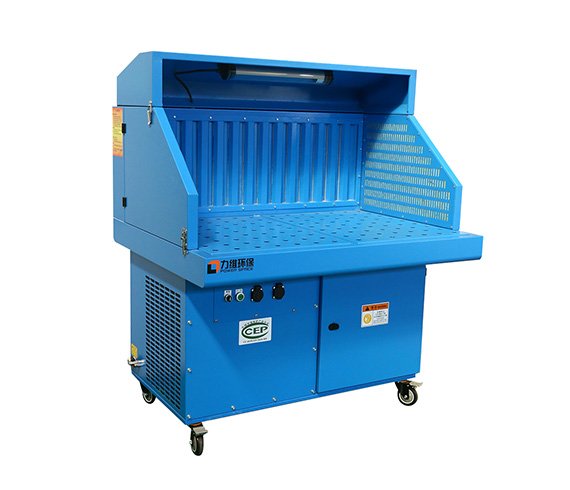
C. Total Volume Containment & Cross-Draft Control: Welding Booth + Cartridge Dust Collector
Best for: Dedicated robotic cells, safety-enclosed multi-robot cells, or heavy manufacturing workcells requiring physical arc/smoke isolation.
Working Principle: Hard/soft-walled modular welding booth captures perimeter diffusion; low-to-medium negative pressure sweeps air via side/low-level louvered exhaust ducts into a central/attached cartridge collector.
Key Specs:
Air volume: 4000-10000m³/h per booth (based on exchange rate 30-60 changes/hr or sweep velocity 0.3-0.5m/s).
Filtration: Main pulse-jet cartridge collector with spark arrestor and acoustic attenuation.
Engineering Tip: Design lower/side slot-suction inside the booth to complement thermal rise without creating cross-draft turbulence over the immediate weld puddle.

(Welding Booth with Cartridge Dust Collector)
3. Engineering Best Practices
Protect the Gas Shield: Never place high-velocity extraction lips (>1.0 m/s) directly adjacent to open MIG shielding gas flows without laminar flow guides or buffer distance inside the welding booth.
Spark Pre-Separation: Equip heavy-duty cells and booth collection ducts with a cyclonic/labyrinth spark arrestor to protect PTFE filter media from burn-through.
ATEX/Safety Compliance: For aluminium/coated steel MIG applications, ensure anti-static grounding and explosion relief panels are configured on the main collector feeding the welding booth system.
Acoustic & Flash Safety: Rigid/modular welding booth panels block UV arc glare, while integrated fan/booth acoustic treatment keeps operating noise below 75dB(A).
Need a custom P&ID or airflow calculation sheet for your upcoming robotic welding booth tender? Contact us, share your envelope dimensions (L*W*H) and shielding gas type to size the exact fan curve and filtration area.