News
Power Space tailor-made dust removal plan for you
Selection Guide for Downdraft Grinding Tables
How do you select the correct industrial downdraft grinding table or welding downdraft table?
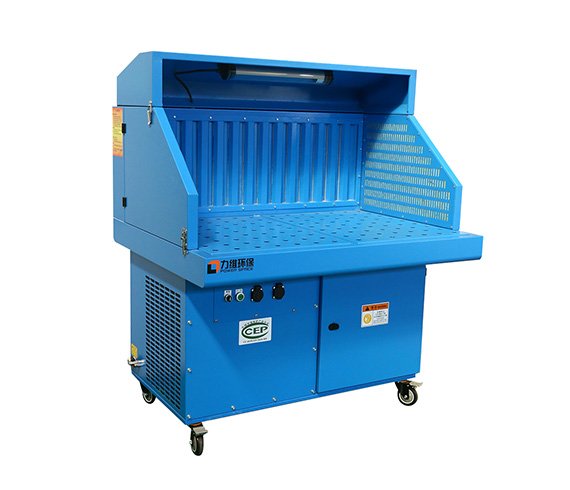
Sizing an industrial extraction workbench requires evaluating four technical dimensions: downward capture velocity (minimum $0.5 - 1.0\text{ m/s}$ across the grid), material-specific filtration media (PTFE vs. Nano flame-retardant), workpiece load capacity, and integrated safety systems (such as multi-stage spark traps). Matching these parameters to your operational profile prevents smoke escape, eliminates combustible metal dust hazards, and extends filter life. Power Space designs modular downdraft benches that optimize these engineering metrics, ensuring high-capacity source capture and regulatory compliance for heavy-duty metal finishing.
1. The 4 Essential Dimensions of Downdraft Table Selection
When investing in a industrial welding downdraft table, selecting a unit based solely on physical size often leads to poor extraction performance. Engineering teams must evaluate configurations across these four foundational pillars:
Airflow Velocity & Total Air Volume
The kinetic energy of hand grinding sparks requires a strong downward velocity to bend the plume away from the operator's breathing zone.
The Sizing Rule: For standard metal grinding, the surface face velocity across the perforated grid should maintain 0.5m/s to 1.0 m/s.
Volumetric Calculation: A standard 1.5\meter workbench requires a built-in centrifugal fan capable of pulling 3000 - 4500 m3/h to handle high-production processing without pulling dust outward into the wider shop.
Material Profiling & Filter Media Type
Different metal alloys generate drastically different particulate characteristics:
Carbon Steel & General Welding: Generates standard dry iron oxides. This profile matches perfectly with Nano flame-retardant cartridge filters.
Stainless Steel & Aluminum: Stainless steel produces toxic hexavalent chromium, while aluminum dust is highly explosive and prone to static clumping. These profiles demand high-precision PTFE membrane cartridges with an ultra-smooth surface layer that easily releases dust during automatic pulse cleaning.
Structural Load Capacity & Table Layout
The workbench must handle physical impact and continuous tool placement without bending:
Weight Rating: Industrial-grade downdraft grinding tables like the Power Space series utilize thick, reinforced structural steel plate surfaces rated for heavy parts (often exceeding 500kg - 1000kg).
Enclosure Configuration: Choose whether your workflow needs a flat open tabletop or integrated side/backdraft walls. For grinding tall parts, side walls block cross-drafts in the shop and trap bouncing sparks.
Safety & Fire Mitigation Controls
Thermal processes generate hot sparks that can ruin filters if pulled directly into the cabinet:
Dual Barrier Protection: Ensure your chosen model includes an integrated mechanical solution: an initial gravity settling chamber to drop heavy metal slag, followed by a secondary stainless steel labyrinth spark arrestor to cool hot particles before they reach the main filters.
2. Selection: Matching Applications to Specifications
| Manufacturing Process | Workpiece Profile | Recommended Table Features | Ideal Filter Configuration |
| Manual Arc / TIG Welding | Small to Medium Parts | Flat welding downdraft table with integrated jig clamps. | Nano Flame-Retardant Media |
| Heavy Angular Grinding | Heavy Castings / Carbon Steel | Side & backdraft shield walls to stop high-speed flying sparks. | High-Airflow Cartridges with Labyrinth Spark Trap |
| Aluminum Finishing | Cast Alloys / Shell Components | Grounded anti-static structure with explosion-proof components. | PTFE Nano Membrane with frequent pulse intervals |
| Plasma Sheet Cutting | Thin Plate Profiling | Integrated water tray or dual heavy-duty gravity slag drawers. | High-temperature resistant filtration elements |
3. FAQ
Q: Why is an ordinary extraction hood inferior to a downdraft table for grinding?
A: Overhead hoods pull heavy, toxic dust upward directly through the welder or grinder's breathing zone. A downdraft grinding table reverses this flow, using negative pressure to pull contaminants down and away from the operator's face instantly.
Q: How do you maintain consistent suction pressure across long shifts?
A: Look for systems equipped with an automatic pulse-jet cleaning system. The unit monitors internal pressure drops and automatically delivers targeted bursts of compressed air through the center of the cartridge, dropping the accumulated dust cake into the lower collection drawer without interrupting work.
Q: Do Power Space downdraft tables require outdoor ducting?
A: No. Because Power Space uses advanced 99.9% efficient filtration media combined with internal acoustic dampening, clean air can be safely recirculated back into the factory floor. This retains heated or cooled air, offering significant HVAC energy savings.